
Everybody Loves Potato Salad

Whatever your plans for the 4th of July, whether it’s a barbecue at home or a picnic at the beach, you will almost certainly want to include that all-American favorite, potato salad. We have some variations on the traditional salad using some of the many delicious and interesting vegetables and herbs now available at the stand. These recipes don’t specify actual proportions. Make your salads according to your individual tastes, and have fun with it!

Fingerling Potato and Crystallinum Salad:
The edible ice plant called crystallinum gives a mild briny flavor and pleasant crunch to this salad. Use small fingerling potatoes – the bite-sized ones work particularly well in this recipe. Boil potatoes until tender and then plunge them into an ice bath. Drain, pat dry, and toss with a vinaigrette made of olive oil, Dijon or stone-ground mustard, and a little lemon juice. Roughly chop some red spring onions and purple bell peppers and add to potatoes. Remove stems from the buds and leaves of the crystallinum (discard stems): add to potatoes, throw in a handful of arugula, and toss well. Garnish with sage flowers.
Nicola Potato Salad with Bleu Cheese
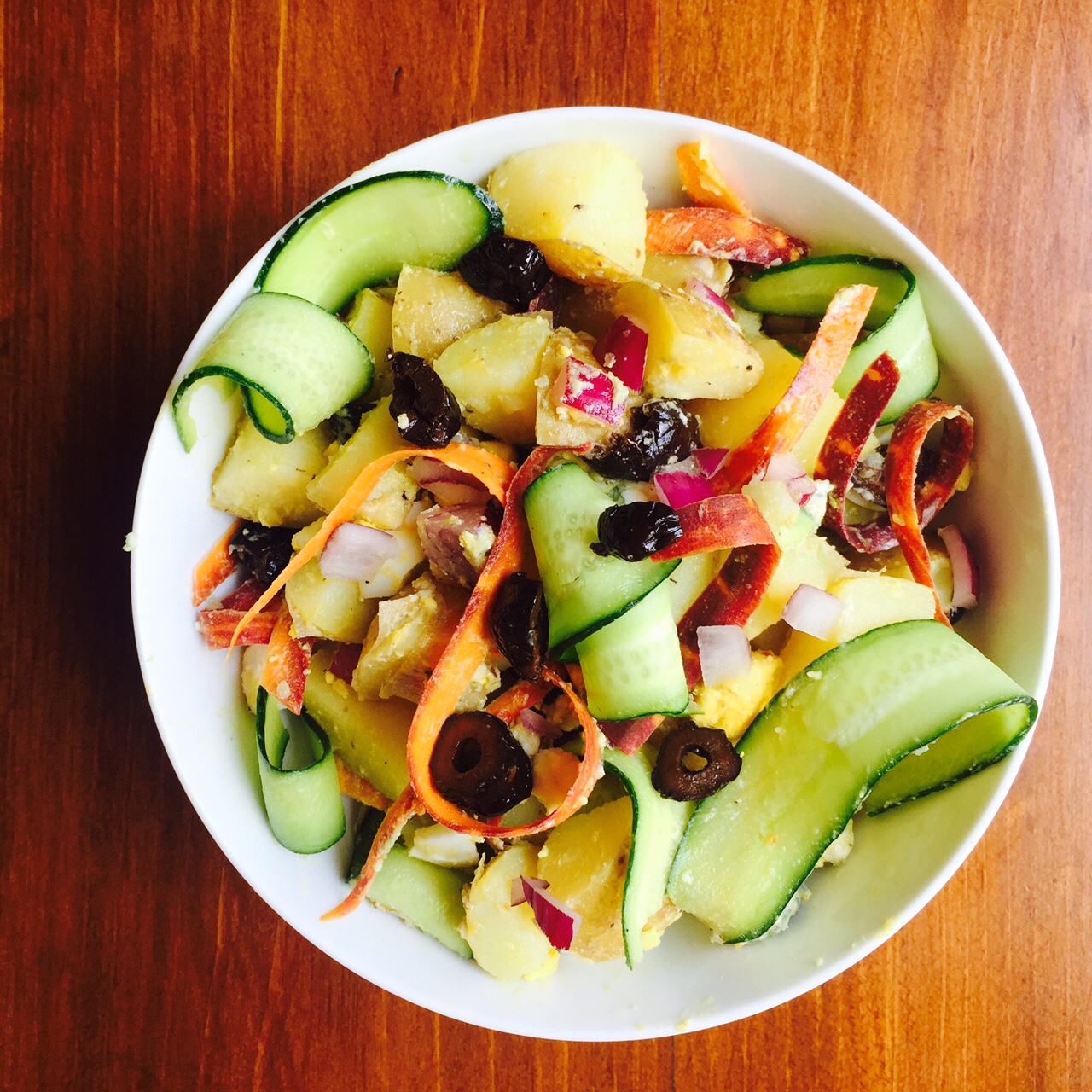
Use the waxy Nicola potatoes – large ones – boil until tender, plunge into an ice bath, and cut into one-inch cubes. Pat dry and season with flaky sea salt and pepper. Put into bowl and add: purple haze carrots and cucumbers sliced into ribbons (a potato peeler works well for this), coarsely chopped red spring onion, coarsely chopped hardboiled pasture-raised egg, a small handful of oil-cured olives pitted and sliced in half, and crumbled bleu cheese of your choice (choose a creamy bleu cheese such as gorgonzola, since the cheese replaces the dressing in this dish). Drizzle with a little olive oil to meld the ingredients and a little lemon juice to brighten the flavors. Chow down!
Potato Salad with Purslane
Steam medium Yukon Gold potatoes until tender, and immediately cut or slice into chunks (don’t use the ice bath for this recipe). Toss potatoes while still warm with mustard vinaigrette (olive oil, a bit of red wine vinegar, Dijon mustard, some minced shallots) so that they absorb the dressing. Toss with sliced spring onions and a good quantity of coarsely chopped purslane. You could add other chopped herbs and greens to taste, such as arugula, watercress, parsley, tarragon, etc. Throw in some capers and add an additional tablespoon or two of coarse mustard if the vinaigrette is not strongly mustardy. Salt and pepper to taste. Garnish with mustard sprouts and/or nasturtium flowers. This salad could be served either when the potatoes are still warm or after they have cooled. (An alternative to tossing the chopped purslane with the potatoes would be to serve the salad on a bed of purslane.)
Choosing the right potato for your salad:
While the flavors of the potatoes in all these salads are very similar, their texture does differ. Fingerling and Nicola potatoes are firm-fleshed, waxy potatoes that stay largely intact when tossed with a dressing. Yukon Gold potatoes are floury and tend to flake when cooked: they are good when you want the potato to absorb the dressing and enjoy your salad somewhat, well, mushy.
Summer Time Happy Hour

Summer is a-coming in, and that means it’s time to raid your liquor cabinet for the essential summer drink: gin and tonic. What speaks of summer more than kicking back on your patio with a refreshing g&t? We have come up with our own version of this classic drink that makes use of some of the glorious summer produce now appearing at the stand. Happy sipping!

The Vegetable Shop Gin and Tonic
Serves 2
- 1/4 cup or more loosely packed fresh herbs, such as a mixture of parsley, lemon balm, and basil.
- 1/4 cup roughly chopped cherry tomatoes. We like to use a mixture of colors for aesthetic appeal.
- 1 small, unpeeled Japanese cucumber, cut into ½ inch dice (about 1/4 cup or more to taste).
- 4 oz dry gin: we love Martin Miller’s in this, but any of your favorite gins, such as Tanqueray Ten, Hendricks, or Plymouth, would work well. (Hint: try to use one that is lightly herbaceous or cucumber-y, rather than one that is juniper-heavy or already laden with an assertive mixture of tastes, as many of the otherwise delicious new gins often are.)
- Tonic water: we like Fever Tree “Indian” tonic water, for its lightness. Q tonic would also work well in this drink. We always prefer tonics sweetened with cane sugar rather than corn syrup.
Herb sprigs or edible ice plant, for garnish. A martini pitcher is great for this, but any pitcher or large, heavy-bottomed glass will do. Place the herbs and cucumber in the pitcher and muddle well. Then add the tomatoes and muddle lightly. Fill the pitcher with medium to large ice cubes, add the gin, and stir. Top with tonic water and stir again lightly. Pour into individual glasses—we love to use our tall, frosted 1940s-era Libbey “candy stripe” glasses. Garnish with the herbs and a slice of cucumber. Alternatively, the edible ice plant now available at the stand would make a beautiful, unique garnish.
(Our recipe is based on the one in Greg Henry’s useful book, Savory Cocktails)
The Vegetable Stand gin and tonic would be perfectly accompanied by our shishito peppers, sautéed in olive oil and sprinkled with salt and pepper. Try our popup stand’s Omnivore salt, or use Jacobsen’s flaky sea salt from Oregon. Another delicious accompaniment would be our marble-sized new potatoes briefly sautéed or roasted and sprinkled with salt. Or you could prepare any size of our new potatoes following April Bloomfield’s recipe for “Salt Crusted Potatoes” in her fabulous cookbook, A Girl and Her Greens, also available at the stand.
Let’s Celebrate Mother’s Day Weekend!
Saturday, May 9: Good Earth/Great Chefs welcomes April Bloomfield

Come to the farm between 11:00 and 1:00 to meet April Bloomfield, owner/chef of Manhattan’s celebrated restaurant, The Spotted Pig. April will be here to sign copies of her new cookbook, A Girl and Her Greens. There will be music, tastings of some of April’s delicious recipes, and good company!
Pick up a copy of April’s book and then visit the stand to stock up on just about everything you will need for a fabulous Mother’s Day brunch.
Sunday, May 10: Mother’s Day Brunch
Menu:
Bellinis made with Chino farm peaches
---
Crostini topped with crushed spring peas and mint
---
Frisée, Radicchio, and Fennel Salad with Mustard Vinaigrette
---
Sweet Corn Polenta with sautéed Wild Spinach and Swiss Chard
Grilled sausages
---
Strawberries with rose geranium whipped cream
Guidelines and options:
For a variation on the classic Bellini made with fresh peach puree and prosecco, try a Rossini, made with pureed strawberries.
Crostini topping recipe:
CRUSHED SPRING PEAS WITH MINT (Makes about 2 cups), from April Bloomfield, A Girl and Her Greens
Ingredients:
- 2 cups fresh peas (from about 2 pounds pods)
- 1 ounce aged pecorino, finely grated
- 1. teaspoons Maldon or another flaky sea salt
- 1 small spring garlic clove or small garlic clove, smashed, peeled, and roughly chopped
- 12 medium mint leaves (preferably black mint)
- 3 tablespoons extra-virgin olive oil
- Scant 2 tablespoons lemon juice, plus more for finishing
Directions:
- Combine the ingredients in a food processor and pulse to a coarse puree, about 45 seconds.
- Scrape the mixture into a bowl and roughly stir and smoosh a bit so it’s a little creamy and a little chunky.
- Season to taste with more salt and lemon juice—you want it to taste sweet and bright but not acidic.
Salad
Try the recipe from Gourmet Live on Epicurious.
Sweet corn polenta
Use the recipe from A Girl and Her Greens, which is a traditional cornmeal polenta made with the addition of fresh corn (now available at the stand). Top with sautéed wild spinach and Swiss chard, and serve sprinkled with sliced spring onions fried until brown and crunchy.
For a vegetarian meal, skip the sausages and top each bowl of polenta with a fried egg.
Rose geranium whipped cream
Begin the night before. Rinse one bunch of rose geranium flowers (available at the stand), approx. ½ cup, (you may use stems and all) and put in a small saucepan with a cup of whipping cream. Heat the mixture over medium heat until simmering, but not boiling. Once cream comes to a simmer, remove from the heat, and cool overnight in the refrigerator. The next day, strain the geraniums out of the mixture, add powdered sugar if desired, and whip the cream. Serve as a dipping sauce for whole strawberries, or drizzled over sliced berries.
Happy Mothers’ Day to everyone!
It’s Spring!
Amandine strawberries
Spring is here, and the stand is overflowing with springtime bounty. We’ll be telling you about our peas, artichokes, asparagus, spring onions, and much, much more in future posts. But right now our thoughts are turning to: STRAWBERRIES. What better way to celebrate the vernal equinox than with these gorgeous, fragrant, and outrageously delicious fruits? Especially when we pair our strawberries not with the traditional shortbread, but with a yummy, easy to make, olive oil cake.
This year, we have three varieties of strawberries: the robust California strawberry, each berry a scrumptious mouthful; the beautiful Mara du Bois, whose heady perfume and delicate flavor evoke the very essence of strawberry; and a lovely new variety, Amandine -- smaller than the California strawberry but larger and firmer than the Mara du Bois -- whose sweetness hits like a starburst on the tongue. Serve any of these berries atop this cake (recipe below), and you will taste spring in each bite.
Our weekend popup store recently began featuring a very special olive oil that is now available all week at the stand. Séka Hills handcrafted olive oil is produced in the beautiful Capay Valley of northern California by the American Indian tribe known as the Yocha Dehe Wintun Nation: in their native Patwin language, “séka” means blue. The Séka Hills farm is committed to sustainability, the conservation of their tribal lands, and the preservation of their culture and heritage. (You can read more about the farm here: http://www.sekahills.com.) Their oil, with its green and citrus overtones and peppery finish, is absolutely delicious in a salad dressing or drizzled over grilled vegetables –- but it also is the key ingredient in their recipe for this outstanding lemon and almond -- inflected cake. Serve this cake topped with our strawberries and bourbon-vanilla whipped cream, and raise your fork to springtime!
Olive Oil Cake Recipe
Courtesy of Emily Luchetti, April 2014
Ingredients:
- Non-stick cooking spray
- 2 cups unbleached all-purpose flour
- 1 cup sliced almonds, toasted
- 2 large eggs
- 1 1/2 cup granulated sugar
- 1 cup Greek plain full fat yogurt
- 1 cup Séka Hills olive oil
- 2 teaspoons baking soda
- 1/8 teaspoon Kosher salt
- 3 tablespoons lemon zest
- sliced strawberries and whipped cream for serving
Directions:
- Move rack to middle of the oven and preheat to 350 degrees.
- Thoroughly coat a 9-cup (10 inch) bunt pan* with non-stick cooking spray. Turn the pan upside down to drain off any pooling spray. Coat the sides, bottom, and tube with flour, rotating and tilting the pan to coat well. Invert the pan to let excess flour fall from the pan.
- In a food processor, process the almonds with 1 cup of the flour until finely ground.
- In a medium bowl, whisk the eggs with the sugar until combined. Whisk in the yogurt and then the olive oil. Add the flour and nut mixture, the remaining 1 cup flour, baking soda, salt, and lemon zest; stir until well-combined.
- Spread the batter into the prepared pan. Bake until a toothpick inserted in the middle comes out clean -- 35 to 45 minutes.
- Let cool on rack for about 20 minutes.
- Unmold by giving the pan a sharp tap on the counter to help release the cake, then invert the pan onto a cake plate or platter.
- Cool fully before slicing with a serrated knife. Serve with strawberries and whipped cream. Optional: garnish with mint sprigs and sliced toasted almonds.
*A well-buttered cast iron skillet also works. Cook time will be roughly the same.
For another way to use the Séka Hills olive oil, try this salad dressing:
Spring salad with pea tendril, nasturtium, and a lemon thyme and lemon dressing.
Séka Hills Meyer Lemon Dressing
Courtesy of Roberta Klugman, April 2013
Ingredients:
- 4 tablespoons Séka Hills olive oil
- 2 tablespoons fresh squeezed Meyer lemon juice
- 1 green onion, chopped
- 1 small clove garlic, minced
- 1 tablespoon minced fresh herbs, such as basil, thyme, or parsley
- salt and pepper to taste
Directions:
- Have all your ingredients measured so you can make the dressing just before tossing.
- Pour the lemon juice into a medium-sized round bottom bowl.
- Slowly whisk the olive oil, about a quarter teaspoon at a time, until all of the olive oil is fully incorporated and the mixture is fully emulsified. Slow addition plus steady constant whisking keeps the ingredients combined for a silky dressing.
- Whisk in the green onion, minced garlic and chopped herbs.
- Season to taste with salt and pepper. Toss with salad ingredients and serve.
Winter's Bounty

Shivering through our “frigid” San Diego nights? Turn on your oven and return to your roots—vegetables, that is!
The stand right now is brimming with vegetables that are perfect for roasting. Roasted vegetables are great as a side dish, but also make a fantastic main course all on their own. Serve them with good crusty bread, such as the amazingly flavorful, chewy baguettes from Darshan Bakery available in our weekend popup store, and you’ve got a very tasty, and warming, winter meal. Roasting vegetables is as simple as it sounds (see link below) – try for fun colors and interesting flavor combinations.

At the stand right now you will find beets, turnips, kohlrabi, carrots, celery root (celeriac), cauliflower, Brussels sprouts, sweet potatoes, leeks, and Negi onions (also called Santa Claus onions for their red and white color). FYI: Kohlrabi and celeriac are less intimidating than they look: just use a sharp paring knife to peel off the thick skin. (A knife works better than a peeler.)
Don’t discard the tops of the turnips, beets, and kohlrabi! These greens, along with the other winter greens now at the stand – chard, collards, kale, mustard, spinach -- are great when sautéed: try them as a bed for your roasted vegetables or in a soup.
Or how about this employee favorite: raw kale salad with leftover roasted Okinawa sweet potatoes, goat cheese, pecans, and dried figs (available now at the stand), tossed with good olive oil, salt, and pepper. The purple-fleshed potatoes look great against the kale’s deep green, vividly flecked with the white cheese: remember that we eat with our eyes, too!
Here’s a link to a New York Times article and video in which Melissa Clark prepares a recipe for a colorful and tasty Lentil Salad with Roasted Vegetables. For more information, check out this Los Angeles Times guide to greens.